
Blueberry Muffin Nutrition: Calories, Macros & Swaps

A typical blueberry muffin can range widely in calories depending on size, from small mini muffins to jumbo-sized ones, with medium bakery sizes typically landing in a moderate calorie range. As a benchmark, most recipes and labeled products average roughly 375 calories per 100 g. That density puts a standard muffin squarely in occasional-treat territory: the refined flour, added sugar, and portion inflation work against it as a daily staple, even with real blueberries in the batter.
The good news? Understanding exactly what’s in your muffin makes it easy to enjoy one without second-guessing yourself, and to bake a smarter version when you want something you can reach for more often.
Key Takeaways
A standard blueberry muffin averages ~375 calories per 100 g, making portion size the single most important variable in its dietary impact — and a high-protein, lower-sugar recipe the most effective fix.
| Point | Details |
|---|---|
| Calorie range by size | Mini (~40 g) runs ~150 cal; medium (~113 g) ~424 cal; jumbo (~180 g) ~675 cal. |
| Per-100 g benchmark | Most recipes and labeled products average ~375 calories per 100 g. |
| Health verdict | Best as an occasional treat; high added sugar and low protein limit daily use. |
| Simplest swaps | Cut sugar by 25–33%, swap half the flour for oat or whole-wheat, add protein. |
| Bell’s Protein Pantry | Their Blueberry Muffin mix delivers 17–19 g protein and 39% less sugar per serving. |
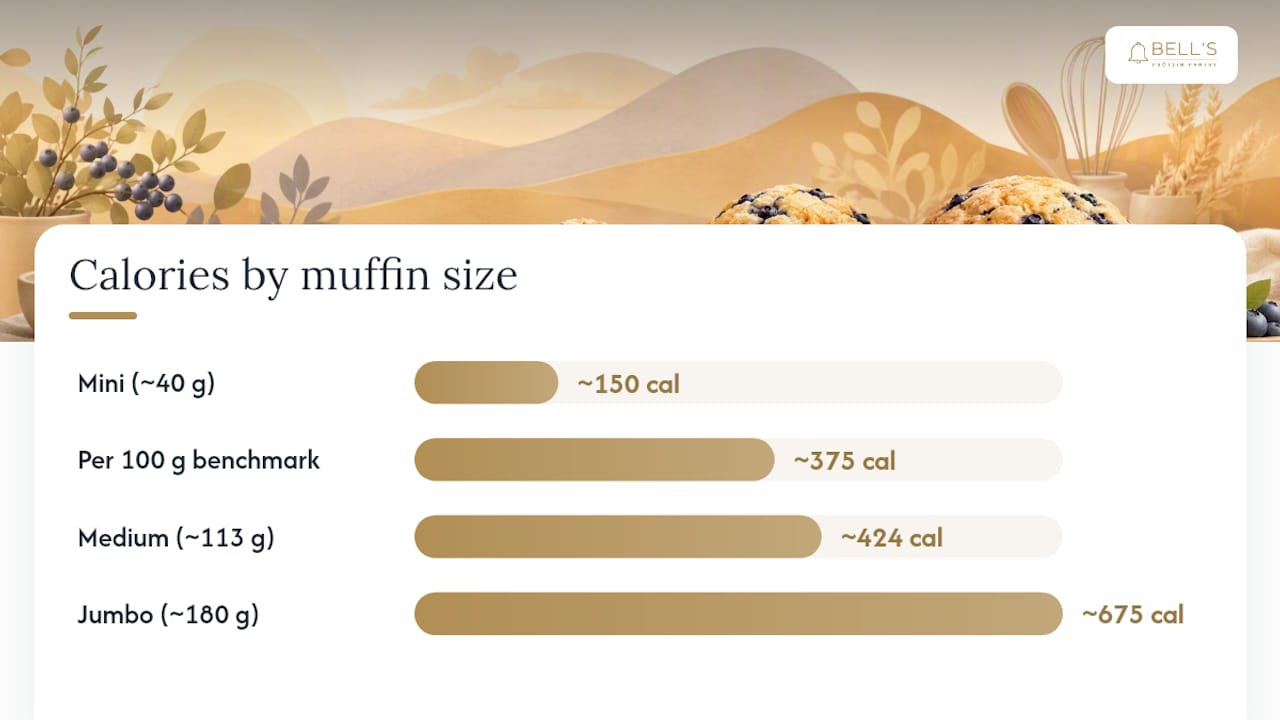
Table of Contents
- Blueberry muffin nutrition facts: per serving and per 100 g
- How portion size changes the calorie count
- Why blueberry muffin nutrition numbers differ so widely
- Blueberries vs. blueberry muffins: what nutrients actually survive
- Are blueberry muffins healthy? A clear-eyed verdict
- How to reduce sugar and boost protein in blueberry muffins
- Quick shopping and baking tips to cut sugar and calories
- Our take on the blueberry muffin nutrition conversation
- A better blueberry muffin is one mix away
- Sources
Blueberry muffin nutrition facts: per serving and per 100 g
Numbers pulled from labeled products and nutrition databases give us a consistent picture. CalorieKing’s labeled example shows 385 calories with 9 g fat, 66.7 g carbs, 3.6 g fiber, and 7.6 g protein — a useful real-world anchor.
Serving size reference:
- Mini (~40 g): approximately 150 calories
- Medium (~110–120 g): approximately 410–450 calories
- Large/jumbo (~150–180 g): approximately 560–675 calories
Values are averages derived from multiple nutrition databases and labeled commercial products. Your muffin’s actual numbers depend on recipe, brand, and weight — check the label or weigh it for precision.
Stat to know: At ~375 calories per 100 g, a blueberry muffin is roughly as calorie-dense as a slice of cheesecake. Most of those calories come from refined carbohydrates and added sugar, with protein typically under 8 g per serving unless the recipe is specifically modified.
How portion size changes the calorie count
The math is simple once you know the per-100 g benchmark: muffin weight (g) × 3.75 = approximate calories. Here’s what that looks like across common sizes.
- Mini muffin (~40 g): 40 × 3.75 = 150 calories. These are the ones at brunch spreads — easy to underestimate because they disappear in two bites, and most people eat three.
- Standard homemade (~57 g / 2 oz): Harvard’s Nutrition Source recipe produces muffins at roughly this weight, coming in around 120 calories with a leaner ingredient list — proof that recipe choices matter enormously.
- Medium bakery muffin (~113 g / 4 oz): 113 × 3.75 = ~424 calories. This is the size most people picture when they say “a muffin.” At a coffee shop, it often comes wrapped as a single serving, so most people eat the whole thing.
- Large coffee-shop muffin (~150 g): 150 × 3.75 = ~563 calories. Some chains serve muffins at this weight or heavier. That’s closer to a full meal’s worth of calories in one item.
- Jumbo (~180 g): 180 × 3.75 = ~675 calories. Bakery display cases frequently feature these. University Hospitals’ nutrition guidance notes that commercial muffins often weigh 150 g or more and can represent two to three standard servings.
No scale? No problem. A medium muffin (~113 g) is roughly the size of a tennis ball. A large coffee-shop muffin is closer to a baseball. If it’s bigger than your fist, it’s almost certainly over 400 calories.
Why blueberry muffin nutrition numbers differ so widely
Two muffins can both be called “blueberry” and land 300 calories apart. Here’s what drives that gap:
- Flour type: Refined all-purpose flour is standard in most commercial recipes. Swapping even half for whole-wheat or oat flour adds fiber and lowers the glycemic impact without a dramatic calorie change.
- Fat source and quantity: Butter, vegetable oil, and cream each add different fat profiles. A recipe using ½ cup of butter for 12 muffins adds about 8 g of fat per muffin from that ingredient alone.
- Sugar quantity and form: Granulated sugar, honey, jam fillings, and glazes all push sugar content up. Action on Sugar’s analysis found some leading commercial blueberry muffins contained up to 40.3 g of sugar per muffin — roughly 10 teaspoons, more than a can of cola.
- Blueberry format: Fresh or frozen whole berries add fiber and antioxidants. Blueberry jam or flavoring adds sugar with minimal nutritional upside. Some commercial products labeled “blueberry” use flavoring rather than meaningful quantities of real fruit.
- Portion size: A recipe that makes 12 muffins from the same batter as one that makes 8 produces muffins with 33% fewer calories each. Portion is often the single biggest variable.
Retail and coffee-shop muffins carry an additional complication: many out-of-home products lack point-of-sale nutrition labeling, so the calorie count isn’t visible until you look it up. Always check before assuming.
Blueberries vs. blueberry muffins: what nutrients actually survive
Whole blueberries are genuinely impressive. Cleveland Clinic’s nutrition data puts one cup (~148 g) at about 96 calories with 3.6 g fiber, 14 g of natural sugar, and meaningful amounts of Vitamin C, Vitamin K, and manganese.

What carries over when blueberries go into a muffin? Some manganese and a fraction of the anthocyanins survive baking, but heat degrades Vitamin C substantially and the anthocyanin concentration is diluted across a large volume of batter. The Frontiers in Nutrition review on blueberry health benefits links cardiovascular, metabolic, and cognitive effects to habitual blueberry intake, with anthocyanins and gut microbiota interactions as likely mechanisms. Those benefits are most reliably obtained from whole or minimally processed blueberries, not from a muffin where the fruit is a minor ingredient by weight.
The muffin does add protein the raw berry lacks, but that protein comes from eggs and flour, not the blueberries themselves.
Are blueberry muffins healthy? A clear-eyed verdict
The short answer: occasionally, yes. Daily, probably not. A standard commercial muffin delivers a significant sugar load, limited fiber, and very little protein, a combination that spikes blood glucose and leaves most people hungry within an hour or two.
Who should be especially mindful:
- People managing blood sugar or insulin sensitivity, given the high refined-carb and added-sugar content
- Children, for whom a large muffin can represent a substantial portion of their daily added-sugar limit
- Anyone on a calorie-restricted plan, since portion inflation makes it easy to consume 400–500 calories without feeling like you ate a full meal
- People relying on muffins as a protein source — at 5–8 g per serving, they fall well short of what’s needed for satiety or muscle support
Practical frequency guidance:
- One medium muffin as an occasional treat (once or twice a week) fits most balanced eating patterns without issue.
- Pair it with a protein source — Greek yogurt, eggs, or a protein shake — to slow glucose absorption and extend satiety.
- For regular consumption, a modified recipe with whole-grain flour, reduced sugar, and added protein is a much better fit than a standard commercial version.
Worth knowing: The American Heart Association recommends no more than 25 g of added sugar per day for women and 36 g for men. A single large commercial muffin can hit or exceed the lower threshold in one sitting.
This article provides general nutrition information, not medical advice. If you’re managing a health condition, check with a registered dietitian or your healthcare provider.
How to reduce sugar and boost protein in blueberry muffins
Small swaps add up fast. Here’s what actually moves the needle:
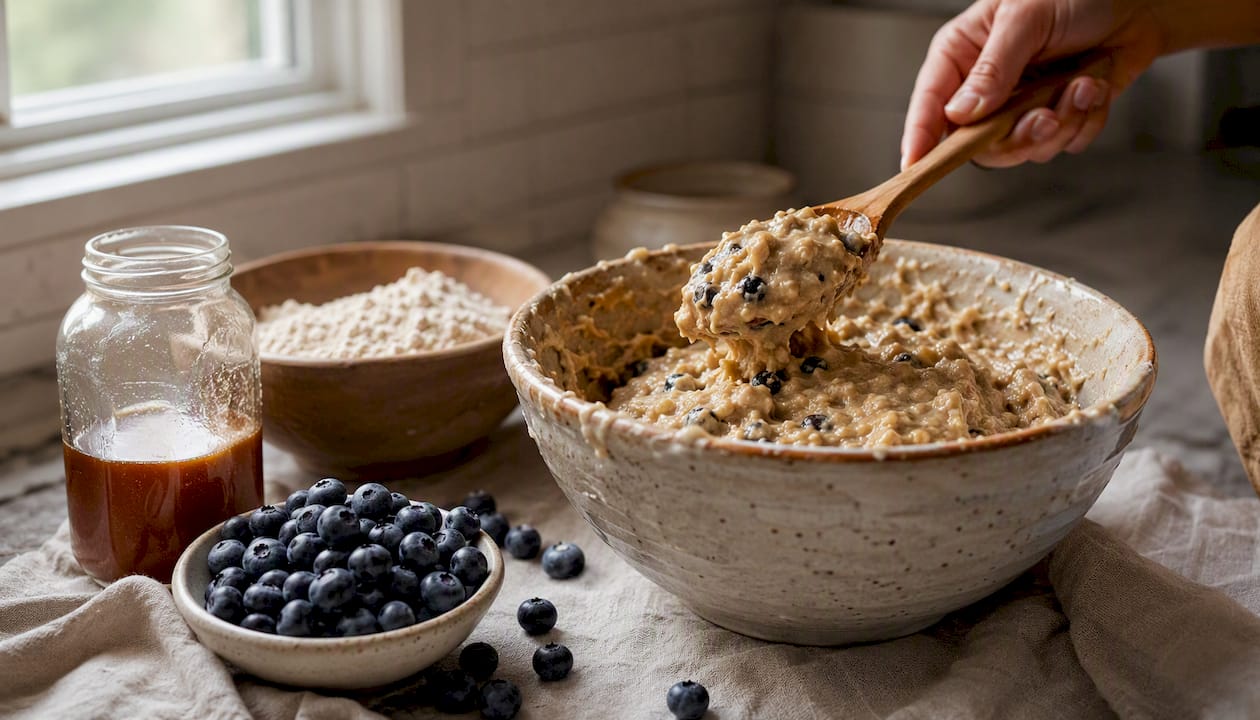
- Swap half the all-purpose flour for oat or whole-wheat flour. You’ll add fiber and lower the glycemic impact. Texture stays close to the original.
- Cut the sugar by 25–33%. Most muffin recipes are over-sweetened. Reducing granulated sugar from ¾ cup to ½ cup in a 12-muffin batch saves roughly 4 g of sugar per muffin without affecting rise or texture.
- Replace part of the fat with unsweetened applesauce or Greek yogurt. Substituting ¼ cup of butter with ¼ cup of applesauce cuts about 400 calories from the whole batch. Greek yogurt also adds protein.
- Use fresh or frozen whole blueberries, not jam. Whole berries add fiber and antioxidants; jam adds sugar and little else.
- Add a scoop of protein powder or use a high-protein baking mix. This is the most direct route to a muffin that actually keeps you full. A high-protein blueberry muffin recipe can push protein to 17 g or more per serving.
- Pair the muffin with protein. Even without changing the recipe, eating a muffin alongside two eggs or a cup of Greek yogurt changes how your body processes the carbohydrates.
Pro Tip: When you reduce fat in a muffin recipe, reduce bake time by 2–3 minutes and check for doneness early. Lower-fat batters dry out faster, and an overbaked muffin is the most common complaint from first-time recipe modifiers.
For a tested, ready-to-use approach, Bell’s Protein Pantry’s healthy blueberry muffin recipe guide walks through these swaps step by step.
Quick shopping and baking tips to cut sugar and calories
When buying:
- Check the serving weight on the label first. If the muffin weighs 150 g but the label shows nutrition for 55 g, multiply everything by 2.7.
- Look at the ingredient list order. Sugar appearing in the first three ingredients signals a high-sugar product.
- Prefer products listing whole fruit (blueberries) before sugar, not after.
- 28 g of sugar = 7 teaspoons. Visualizing it that way makes the number real.
When baking:
- Halve the sugar in any standard recipe as a starting point. Taste the batter — you’ll likely find it’s still plenty sweet.
- Fold in an extra half-cup of fresh blueberries beyond what the recipe calls for. More fruit means more fiber and more flavor without adding calories from fat or refined carbs.
- Swap half the flour for rolled oats blended into a rough flour. It changes the texture slightly (denser, more satisfying) and adds soluble fiber.
- Use a standard muffin tin rather than a jumbo tin. The same batter makes 12 reasonable portions instead of 6 oversized ones, and the per-muffin calorie count drops by half.
- For low-sugar baking ideas beyond muffins, the same principles apply across most quick breads and bars.
Our take on the blueberry muffin nutrition conversation
We think the “healthy vs. unhealthy” framing misses the real question, which is: what are you actually eating, and how often? A 120-calorie homemade muffin made with whole-wheat flour and fresh blueberries is a genuinely different food from a 560-calorie coffee-shop version made with refined flour, jam filling, and a sugar glaze. Treating them as the same thing because they share a name leads to a lot of unnecessary guilt on one end and a lot of unexamined overconsumption on the other.
What we’ve seen in building Bell’s Protein Pantry is that most people don’t want to give up baked goods. They want baked goods that work for them. A muffin at that protein level changes the satiety math entirely — it’s no longer a snack that leaves you reaching for something else an hour later. It becomes a meal component. That shift is what we were after, and it’s what the Bell’s Blueberry Muffin mix was built to deliver.

The conventional wisdom says “eat less of the bad stuff.” We’d rather help you make the good stuff better.
A better blueberry muffin is one mix away
If the nutrition numbers in this article made you want to rethink your muffin routine, Bell’s Protein Pantry’s Blueberry Muffin mix is the most direct path to a muffin that fits your goals without requiring a nutrition degree to bake.

You’re not trading taste for macros — you’re getting both. Whether you’re meal-prepping for the week or just want a smarter grab-and-go option, this mix closes the gap between what a blueberry muffin usually is and what it could be.
Browse the full lineup of protein baking mixes and find the one that fits your routine.
Sources
- Calories in Blueberry Muffin
- Calories in Blueberry Muffin: Complete Nutrition Breakdown & Analysis - Nutrition Facts Data
- Blueberry Muffins - The Nutrition Source - Harvard University
- Blueberries - Health Cleveland Clinic
- The state of the science on the health benefits of blueberries: a perspective - Frontiers in Nutrition
Numerical values in this article are averages and benchmarks. For precise tracking, weigh your muffin and check its specific nutrition label.
This article is general information, not a substitute for advice from a qualified doctor. Consult a qualified healthcare professional about your own circumstances before acting on anything here.